Making Games Tips for New Game Developers
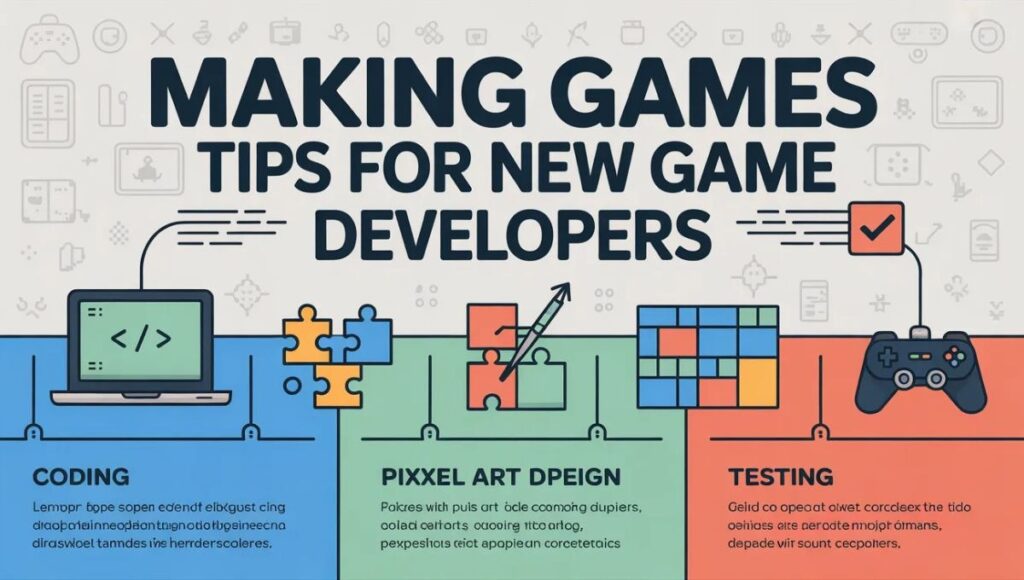
Making games is a complex process of developing a game concept into a runnable game. This ranges from level design to story scripting to gameplay scripting to playtesting and playtesting. In the end, producing games is all about making your dreams a reality in the form of a game. A lot of students and newcomers are now interested in making games because they are such a huge part of modern entertainment. From a rough concept to a playable game, what can begin as nothing more than a simple idea in someone’s mind is able to evolve into a real game that other people play.
Today, more young developers are interested in making games than ever before. They play games and watch people play, and all of a sudden, they think, “What if I could make something like this?” This ambition is frequently the initial step for many people. It might seem intimidating at first glance, but numerous successful developers got their start with small ideas and simple practice.
Some are point-to-point weaves on grids, others are fractals, and there are also online communities and independent hubs of people working on fresh ideas for games, sharing projects, and learning from each other. Amid those discussions, names like Astrocade even sometimes come up as potential new gaming platforms and interactive experiences. These concepts are also helpful for new game developers themselves (and should inspire anyone interested in developing games.
Start Small Projects
They think up a sprawling world, intricate mechanics, and numerous levels. But once they get to work, the game is too big and confused , a mess. That can quickly turn into frustration and quitting. Starting with a very small concept is a much more productive way of working. A simple puzzle, a mini platform game, or a single shooting level can teach far more than a half-baked mega project.
Small games also provide a useful lesson for game-design novices: understanding how game systems interact. They discover how characters move, how scores are kept, and how players cooperate or compete with their world. Every small project becomes practice. With each iteration, the developer gains more confidence working with his tools and with design thinking.
Learn Basic Tools
“Stuff like game engines enable designers to build levels and put things in motion and drive gameplay without coding everything from scratch.” That is normal. Every developer feels that way in the beginning. The important thing is to explore slowly. Baby steps, baby steps. That is the point: To learn. Even if a game looks simple or a little rough, it still teaches you something that you can use.
These tools are familiar to you now, over time. What once seemed confusing begins to feel right. That is when the creative side of making games becomes stronger. Developers stop worrying about the technical basics and start thinking more about ideas, gameplay, and player experience. This is real creativity starting to thrive.
Focus Player Experience
But that is not always the case. It doesn’t matter how many things you have in a good game. It’s how you , the player, think the game is while playing it. These questions contribute to better design. It doesn’t take much to make a simple game wonderful if the experience hooks the player.
A beginner who cares about the fun the player has during the game will learn more, faster, than one who just tries to make something huge or flashy. Kids making games should playtest them with friends. Feedback gets the game better, piece by piece. One of the best ways to grow as a developer is to listen to your players.
Practice Creative Ideas
Creativity is part of game design, and it develops with practice. A developer doesn’t have to wait for a perfect idea to start a project. Game development students should allow themselves to pursue odd or off-the-wall ideas, too. These experiments can help developers find their creative voice. Sometimes the intent is not to make a perfect product, but to find interesting possibilities.
Over time, developers learn to predict. They know which mechanics are engaging and which ones are dull. This is a learning process that is necessary in order to make standout games. Creativity is greater when it is fostered by experimentation and curiosity. Students learning game development should consider this early project training. It is not meant to be perfect.
Keep Learning Always
The developer’s knowledge gets something out of every experience. ” Maybe a puzzle game based on time control, maybe a simple racing game with funny physics, or maybe a story-driven experience with emotional moments.” Many great developers created rounds and rounds of small experiments before they ever made something larger. So no, nothing should be holding you back from starting small. It is actually the smartest way to start.
Straightforward lesson: be patient. Developing games is a process. You can’t avoid making mistakes, and you may as well get started early when things progress at a snail’s pace at first. But those mistakes are part of the journey. Making games isn’t merely technology. It is also about persistence and curiosity.
Conclusion
Novices don’t need perfect tools and huge teams in order to get started. What they really require is to be curious, patient, and to keep getting better little by little. When authors concentrate on learning and exploring, their writing gradually improves. Eventually, those little experiments grow slowly into real experience. That experience is way more important than chasing a big idea too early.
It’s a creative craft where gameplay and mechanics give life to ideas and concepts, just as much as ideas and concepts inform gameplay and mechanics. All kinds of developers get their start on small games to test the water, then move on to much bigger things. Some might even simulate gameplay from titles akin to a game like Purr-Fect Brew-cafe, simply to try out new systems or ideas.
FAQ,s
What’s game development?
Game development is the art of creating game designs and content using digital tools and programming. It transforms ideas into interactive experiences that can be enjoyed by players.
Can beginners make games?
Indeed, even complete novices can make one or two games with some simple tools. Many developers start by learning simple concepts in game engines.
Why is the production game so popular?
Creating games is more popular, as there are more tools and tutorials free on the internet. Students and creators can get up to speed on game development easier than ever before.
How long does it take you to learn to make games?
Learning to make games takes time and depends on practice. You can learn some basics fairly quickly, but it usually takes a good deal of work.
Is making games good for students?
Yes, creating games can be fantastic for students, as it fosters creativity, logic, and technical skills. It also promotes experimentation and collaboration.